

Following our insightful exploration of Uganda’s entry into the Ghanaian market, we now shift our focus on Nigeria—a market with significant potential, but distinct challenges. This blog is part of our ongoing series detailing Imani Development’s efforts under the African Continental Free Trade Area (AfCFTA) to optimize Uganda’s export strategies across Africa.
Nigeria, often referred to as the “Giant of Africa” — not only because of its large population but also due to its robust economic framework — presents a substantial opportunity for Ugandan exporters. As Africa’s largest economy, Nigeria showcases a complex yet promising economic landscape. The country’s economy, predominantly driven by the private sector, contributes around 65% of total domestic expenditure. Despite a tumultuous economic dip in 2023 with a GDP decline of over 18%, projections indicate a recovery that could stabilize and foster economic growth by 2026. However, prospective exporters must consider the country’s economic volatility, which includes a high inflation rate and significant currency depreciation.
Identification of Market Opportunities
The market strategy for Nigeria identified several key products with potential for successful export. This involved an extensive trade analysis to pinpoint sectors with the highest growth potential and alignment with Nigeria’s import patterns. A rigorous selection process followed, factoring in market demands, competitive landscapes, and logistical considerations to ensure selected items matched both current and future market needs. Tobacco, Palm oil and Medicament exports to Nigeria were seen to hold the greatest potential for Ugandan exporters.
High Potential Products:
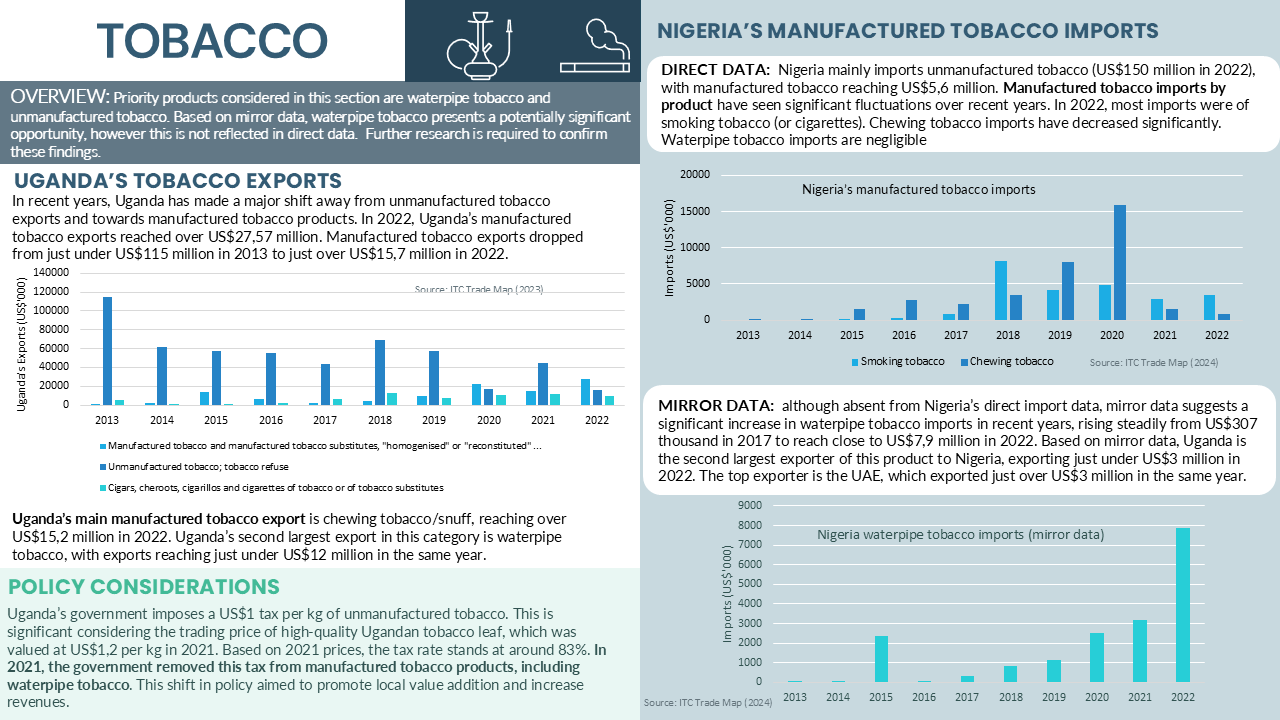
1. Tobacco Products: In recent years, Uganda has made a major shift away from unmanufactured tobacco exports towards manufactured tobacco products. In 2022, Uganda’s manufactured tobacco exports reached over US$27,57 million. Its main manufactured tobacco export is chewing tobacco/snuff, reaching over US$15,2 million in 2022. Uganda’s second largest export in this category is waterpipe tobacco, with exports reaching just under US$12 million in the same year. Both waterpipe and unmanufactured tobacco appear as top products for export potential due to significant demand in Nigeria. Uganda’s potential in this sector hinges on ramping up local processing capabilities to meet Nigeria’s import quality expectations and bypassing the competitive edge of established tobacco-producing countries.
Source: ITC Trade Map (2024)
2. Medicaments: Demand for medicament imports in Nigeria is high, but local production is limited. Medicament imports have increased significantly over the years, rising from around US$165 million in 2015 to reach over US$608 million in 2022. Despite high regulatory barriers aimed at boosting local production, there exists a tangible market for imported medicaments. This is particularly because local production still falls short of meeting the growing demand. Uganda could benefit from expanding its pharmaceutical production base, supported by governmental incentives, to tap into this market.
3. Palm Oil: Demand for palm oil imports in Nigeria is high and has grown substantially in recent years, presenting a potentially attractive market for Ugandan exporters. With a vast consumption base, palm oil and its fractions have a ready market in Nigeria.
Products with Limited Potential:
1. Low-Fat Milk Powder: Demand for dairy products is high, at about 1.3 billion tons per annum, but only 10% of this is sourced locally. As a result, Nigeria is highly dependent on dairy imports. In 2022, Nigeria’s milk imports reached around US$345,5 million. US$193 million were imports of low-fat milk powder, making this the highest demanded dairy product import. The dairy sector presents a challenging landscape due to strict import restrictions that permits only six Nigerian companies to import dairy products. Furthermore, competition from major dairy-exporting nations like New Zealand poses a high entry barrier.
2. Cured Fish and Banana Flour: Both products face limited demand in Nigeria. The cost of transportation and preservation makes these products less feasible for export on a large scale.
Exploring Service Sector Opportunities
Uganda, known as the “Pearl of Africa,” offers a unique blend of natural beauty, rich culture, and diverse wildlife that positions it as an attractive destination for Nigerian outbound tourists seeking new and enriching travel experiences. These adventure tourism opportunities are a significant draw for younger Nigerian travellers and those seeking active vacations. Recognizing the preferences of Nigerian tourists, Uganda’s tourism operators are increasingly offering tailored experiences. These include luxury safari packages, cultural immersion tours, and bespoke adventure trips that cater specifically to the tastes and preferences of Nigerian travellers. The connectivity between Uganda and Nigeria is facilitated by frequent flights, making it easy for Nigerian tourists to visit. Direct flights from major cities like Lagos and Abuja to Entebbe reduce travel hassle and make Uganda an accessible destination for weekend getaways or extended vacations.
Addressing Market Entry Barriers
Exporting to Nigeria involves navigating a complex array of non-tariff barriers. These include stringent import bans on certain categories like dairy and sugar, which are protected to boost local production. Additionally, understanding and adhering to the varied regulatory standards that govern imports can pose a significant challenge but is crucial for market access.
Logistics and Distribution Considerations
Efficient logistics are key to successful market penetration in Nigeria. Factors such as the method and cost of transportation, as well as the efficiency of Nigerian ports and customs processes, play a critical role. For instance, while sea freight from Uganda to Nigeria offers a relatively cost-effective logistics option, the associated time and potential delays at customs can impact product freshness and overall feasibility, especially for perishable goods.
Conclusion
The Nigerian market, with its vast population and economic size, offers a lucrative opportunity for Ugandan exports across several product categories. However, success in this market requires a nuanced understanding of its regulatory environment, consumer preferences, and logistical challenges. By strategically addressing these areas, Ugandan exporters can effectively capitalize on the opportunities presented by Nigeria’s dynamic market landscape.
About Jarrod
 Jarrod Patrick is an Analyst based in our Cape Town office. He holds a Bachelor’s in Economics and Statistics, and recently completed a post graduate in Development Finance from the University of Cape Town’s Graduate School of Business. He has a keen interest in trade analysis, international development as well as social and economic issues that affect developing countries.